Fashion · Footwear · Trainers
Adidas
Adidas Stan Smith
Since 1963 · 61 years to 2026 · First made in Herzogenaurach, Germany




The Adidas Stan Smith represents an unusual convergence of sporting innovation, commercial strategy, and cultural longevity. Conceived by Horst Dassler as the first leather tennis shoe, it emerged from Adidas's commitment to athletic performance through material advancement. The shoe's perforated three stripes, a distinctive design feature, were engineered for air circulation and breathability—practical solutions to the demands of professional tennis rather than aesthetic choices. When first released in 1965 as the Adidas Robert Haillet, the shoe bore the name of the French player for whom it was developed, establishing a pattern that would define its entire history: the shoe as a vessel for an athlete's reputation.

The transition to Stan Smith's name in 1973 marked a strategic pivot toward the American market. Smith, a recent Wimbledon champion and former world number one, brought both sporting credibility and commercial appeal. Unlike many athlete endorsements, Smith's partnership with Adidas proved durable and mutually beneficial—the shoe became a market opener for Adidas in the United States while Smith received royalties on a product that would outlast his playing career by decades. The shoe's classic silhouette and green-and-white colorway transcended its original purpose as a performance tennis shoe, becoming a cultural object that moved between athletic courts, street fashion, and high-fashion collaborations.

.jpg)
The Stan Smith's endurance reflects both design restraint and strategic management. The shoe's essential form—white leather upper, rubber sole, green heel cap—has remained recognizable across fifty years of production, allowing it to function as a stable reference point even as materials and manufacturing processes evolved. The deliberate market withdrawal in 2011, followed by a carefully orchestrated relaunch in 2013 with designer collaborations and limited editions, demonstrated that longevity requires active curation rather than passive continuity. Recent sustainability initiatives, including recycled material uppers and experimental mycelium-based alternatives, suggest the shoe continues to adapt to contemporary manufacturing concerns while maintaining its fundamental identity. The Stan Smith endures not through immutability but through a balance between consistency and selective reinvention.
Timeline
- 1963 First made · Disputed Adidas Stan Smith enters production in Herzogenaurach, Germany.
- 1965 Designed The shoe is redesigned with Haillet branding.
- 1967 Designed Green foam padding is added for achilles tendon protection.
- 1973 Released The shoe is renamed and rebranded with Stan Smith's name.
- 2011 Production Adidas removes the Stan Smith from the market.
- 2011 Paused Adidas deliberately stopped production of the Stan Smith in 2011 as a business decision to create scarcity and rebuild demand. Production resumed with an initial wave in January 2014. Both Wikipedia and The Branding Journal confirm the stop and restart; this was not wartime, corporate distress during which the line kept running, or a factory move — it was an intentional withdrawal from the market.
- 2013 Released The shoe is relaunched for its 40th anniversary with new marketing strategies and designer collaborations.
- 2013 Resumed Production resumes.
Milestone dates are taken from the production notes behind this entry and have not been checked separately.
More like this
-
 Trainers · since 1917 Converse Chuck Taylor All Star Basketball shoe that became an American artifact. Read the entry →
 -
 Trainers · since 1916 Keds Champion The first mass-marketed canvas sneaker, continuously produced since 1916. Read the entry →
 -
 Boots · since 1960 Dr. Martens 1460 Eight-hole boot introduced 1 April 1960, still in production. Read the entry →
 -
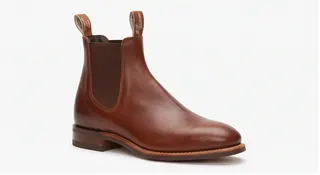 Boots · since 1966 R.M. Williams Craftsman Single piece of leather boot, handcrafted in Adelaide since 1932. Read the entry →