Lemnos (Takata Lemnos)
Lemnos Riki Clock
Since 2003 · 23 years to 2026 · First made in Toyama, Japan
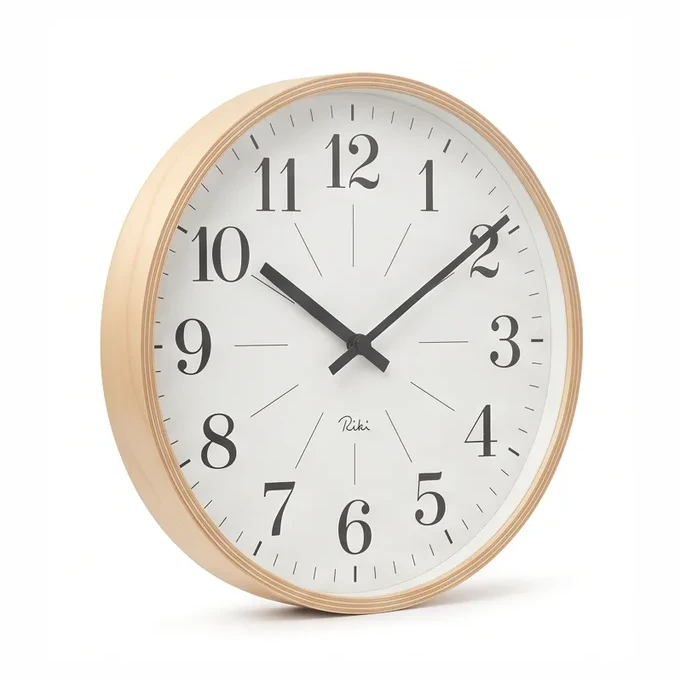
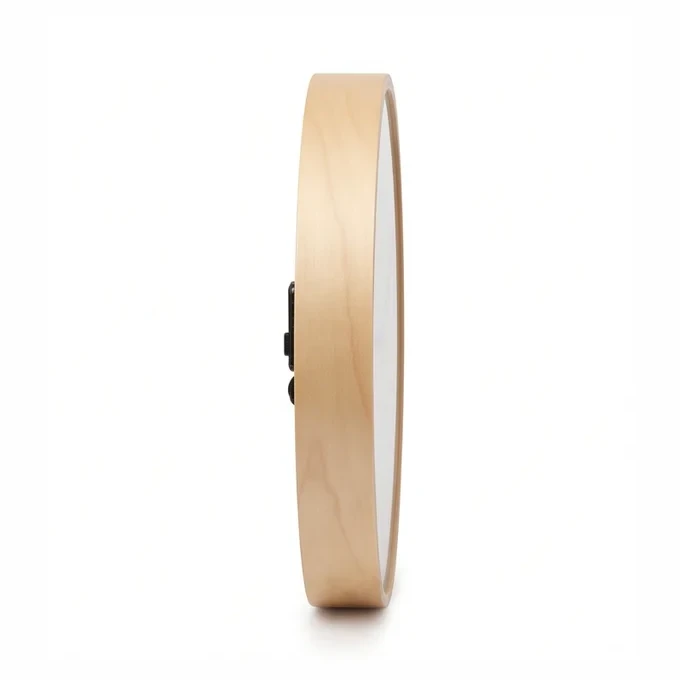
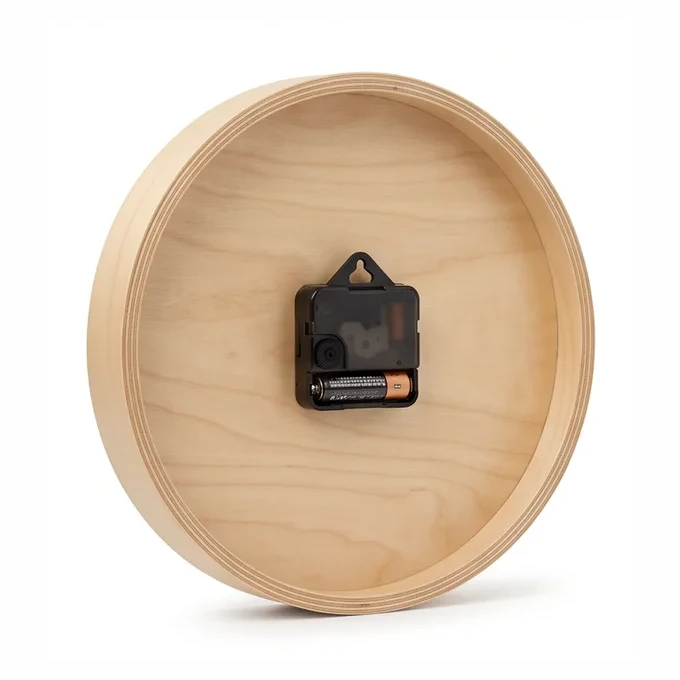

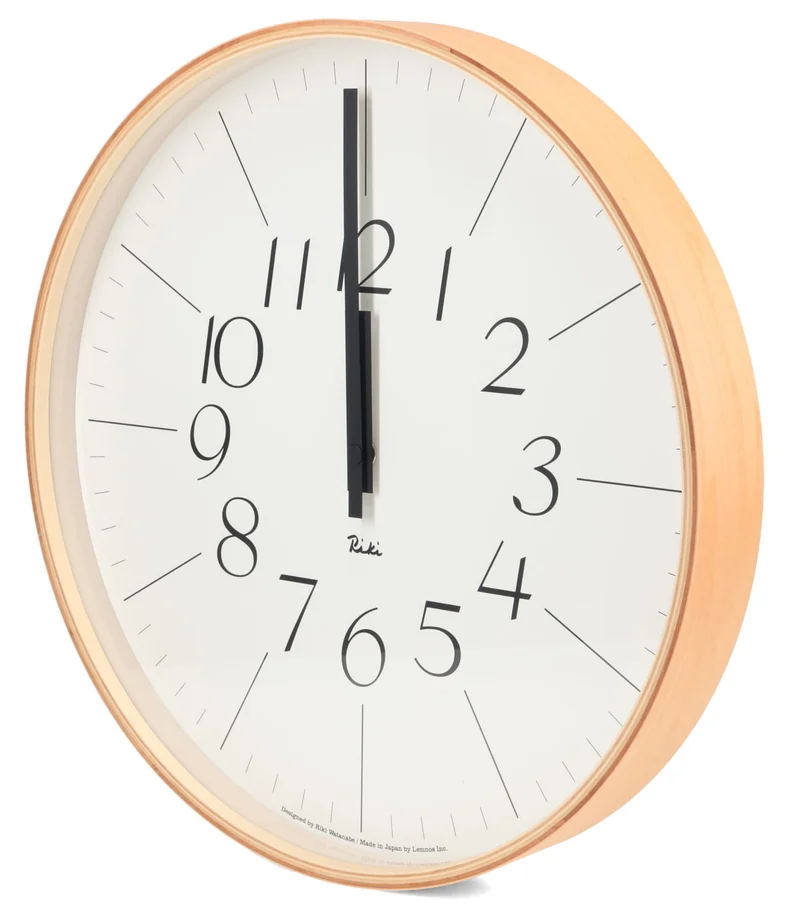
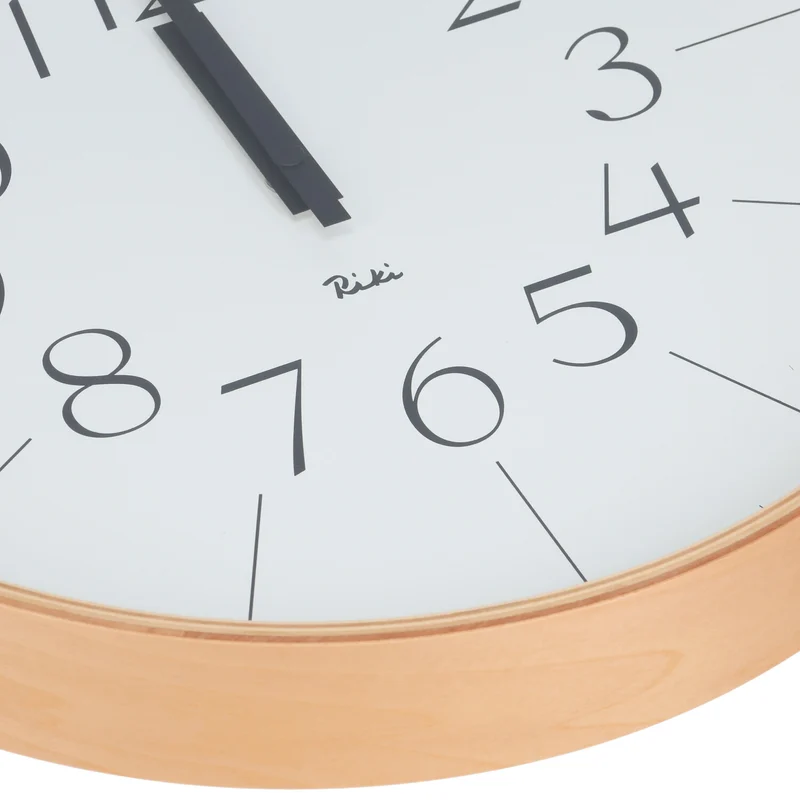
The RIKI CLOCK is a round wall clock with a frame of bent plywood, left in its natural pale colour, and a plain white dial under glass. Twelve tall, slender numerals stand among fine strokes radiating from the centre, and two black hands, sharply different in length and weight, turn over them. The numerals are set in Bernhard Tango, a light face with a faintly written quality. The large WR-0312 L is 354 millimetres across and has no seconds hand; the small WR-0312 S, 203 millimetres, has a sweeping one.
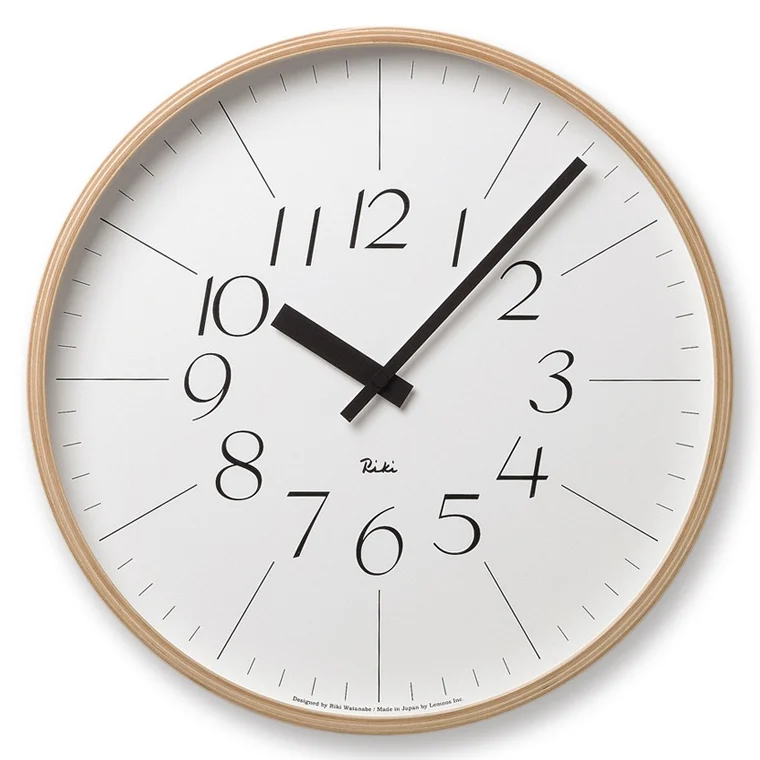
Its designer, Riki Watanabe, born in 1911, was one of the founders of modern design in post-war Japan. He set up a design office in 1949, and clocks became his life's work: a small wall clock for Seiko in 1970, the pole clock that has stood at Hibiya since 1972. Modern design was little valued, his collaborator Akira Yamamoto writes, and by the late 1980s Watanabe's designs for mass-produced clocks had come to an end.
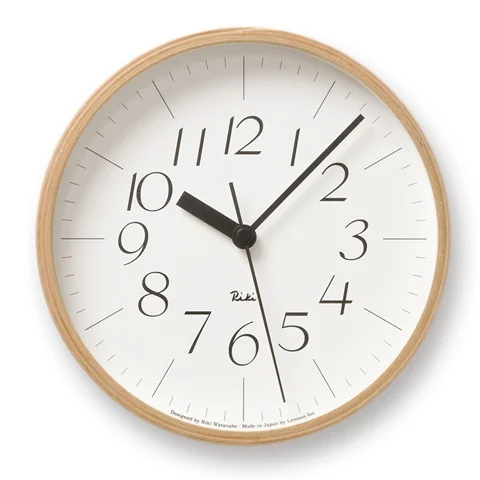
Lemnos, a firm in Takaoka that began in 1947 casting brass Buddhist altar fittings and went on to make clock cases for Seiko, was introduced to Watanabe through Yamamoto. Watanabe wanted lightness; the company's president, Hiroshi Takata, had been looking for a use for plywood frames. The frame of the clock that followed, which Japanese Wikipedia dates to 2003, was made by a woodworker who had long built tambourines and drums. A second dial, in the bolder CBS Didot numerals Watanabe had favoured since the 1970s, followed as WR-0401 and is sold beside it.
The clock won a Good Design Award in 2004 and became, in Lemnos's words, the clock that represents the company. Watanabe died in 2013, aged 101. Lemnos still sells both sizes from its own shop, alongside radio-controlled versions and an alarm clock that carry the same name, and describes it in the terms Watanabe set: large numerals, hands of clear contrast, a simple and light frame.
Timeline
- 2003 First made · Claimed Lemnos Riki Clock enters production in Toyama, Japan.
- 2003 Designed Riki Watanabe designs the RIKI CLOCK for Takata Lemnos, with Bernhard Tango numerals and a bent plywood frame.
- 2004 Recognised The RIKI CLOCK, WR-0312 and WR-0401, wins a Good Design Award.
- 2006 Recognised The National Museum of Modern Art, Tokyo, holds an exhibition of Watanabe's living design.
- 2013 Riki Watanabe dies aged 101; Lemnos continues to make the clock.
Milestones as we found them, not as we've checked them.
From the archive
More like this
-
 Clocks · since 1932 Kit-Cat Klock A grinning cat that has rolled its eyes and wagged its tail over American kitchens since the Depression.
-
 Lighting · since 2012 Philips Hue Smart Bulb The first commercially available smart bulb, continuously refined since 2012.
-
 Lighting · since 1987 Artemide Tolomeo Table Two aluminium arms, a pair of steel cables and a swivelling cone, balanced on a desk since 1987.
-
 Lighting · since 1977 Oluce Atollo 233 A dome, a cone and a cylinder of lacquered aluminium, made by Oluce to Vico Magistretti's design since 1977.